

October 29, 2021

Eckhard Kemmerer – Briometrix Co-Founder
There are a few things you should know about effort
- it’s complicated,
- optional (more on that later) and
- it can be measured.
For a long time, the talk around wheelchair use was about accessibility. And rightly so. For those who suddenly found themselves confined to a life of limited mobility, decisions that were once taken for granted now took careful planning. A meal at the pub or a trip to the park became an exercise in scoping out footpaths, door widths and proximity to bathrooms.
That was certainly the case for Brisbane local Bevan Kearsley when he found himself in a wheelchair three decades ago.
“My mates would say, ‘Let’s go down to the pub for a couple of beers or a restaurant.’ They don’t think whether it’s accessible or not for somebody in a wheelchair,” Bevan says, “There’s no need for them to think.”
That sheer effort of getting out and about was barely on the radar of councils and accessibility advocates at the time. After all, effort is personal. It could hardly be voiced let alone measured.
Until now.
Briometrix Head of Product Eckhard Kemmerer and his team have worked tirelessly to measure and collect data on effort and the result has opened up new avenues for independence not just for the wheelchair community (where Briometrix has its roots) but for the revolution in small wheels in our cities.
Eck’s lightbulb moment came when he was watching the subtle cues of wheelchair users approaching kerbs: the slight hesitation, the mental calculation and the fear of toppling over. It was then that Eck realised that mobility was much more than getting from A to B.
“Effort is not just physical exertion – it has mental and emotional factors that most of us never think about. When we think about the effort it takes to get out and about, we need to apply the lens of effort,” he says.
“If you think about the power you generate from riding a bike at 400 watts, the power from walking at 100 watts and then compare that to wheelchair users who generate between 10 to 30 watts almost exclusively from the power in their shoulders, then you can see that the conditions – and not just direction – matter,” Eck explains.
Bevan agrees, “So you think about all the stresses you put on your legs in normal, daily living. We put that on our shoulders.”
Eck explains that the gradient, crossfalls and surface roughness all have a significant drag on power reserves of wheelchair users and he wanted to find a way to measure effort.
Enter the Brio Scout– a motion sensor recorder that measures multiple points of data.
Brio pilot Bevan explains how it works.
“The Scout doesn’t only just measure the direction you’re going, but the effort it takes. It measures the camber and the slope of the footpath because a lot of the time, all footpaths slope down to the street. And when you’re wheeling along, you’re using more effort on one hand then the other to keep your wheelchair straight,” Bevan says.
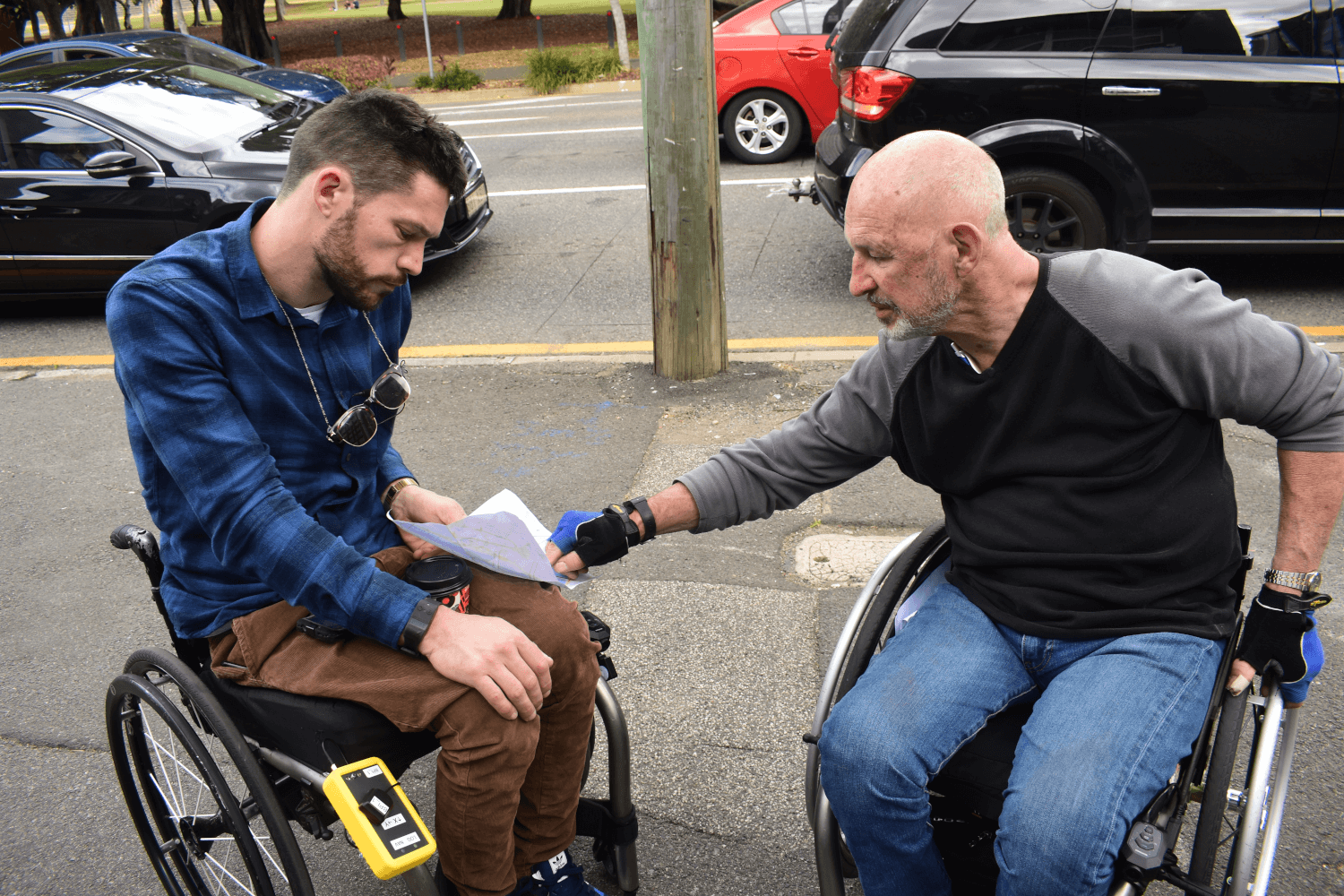
Wheelchair Pilots Lachlan and Bevan in early days of Briometrix development
For those of us who shirked the gym this morning, we know that effort is optional.
For wheelchair users, pram pushers and elder citizens, effort is a key part of getting through each day.
We can now measure effort – and we need to think about it.
